
Family Stories

  • A Month In, and We Are Still Figuring It Out

    I have not written about Adri starting high school yet, and I think that is because we are still in the middle of it. He started in September. We are a month in. Both of us, him and me, are still getting the hang of this.

    I did not want to write a tidy update when it is not a tidy season.

    The summer of quiet worrying

    I spent the summer in a kind of low background worry. It was not active. I was not sitting on the couch spiraling. It was more that it lived in the back of my head all the time, a little hum I could NOT switch off.

    What I remember most clearly is wanting it to happen already. I wanted to be past the unknown. I wanted him to be in the building. I wanted to start working with him from the real place instead of the imagined one. Worry does not do well with waiting, and the summer was a lot of waiting.

    I was also worrying about Guille.

    He started primary school this year. First grade. New classroom. New classmates. A different lunch playground. The teachers at his school already know him, and they knew Adri too, so I keep telling myself he is more protected. He is in two classrooms, one special education and one regular class, and both have adults who know him. That is a gift and my peace of mind.

    But Guille does not communicate the way most children do. If something feels wrong, he is not going to come home and tell me in sentences. I will have to read his body. I will have to listen to what the teachers see. I will have to trust that the people around him are watching the small signs. And I am sure they do.

    Worrying about Adri is one thing. Worrying about a child who cannot always tell you what is wrong is a different kind of worry entirely. And even though Adri comunicates more he is not going to tell me if something good or bad happened at school.

    What high school actually looks like

    Adri walked into a school with one hundred and fifty new students from different schools. He is twelve. He has a very specific way of communicating, and people do not always understand it the first time if they do not know him.

    That was the part that woke me up at night.

    I know Adri. I know what he thinks about. He is not thinking about which clothing brand is cooler or whether this notebook is better than that one. The things that come up in teen conversation are not what live in his head. He is thinking about history. He is thinking about his trains. He is thinking about what day he has swimming and what day he has therapy. He is building his week in his head like he builds everything in his head, carefully and completely.

    The social gap between him and his classmates is becoming more visible this year. His old classmates who came with him to the new school are turning into teenagers. And I can see that even though they do care for him they are growing apart, and that breaks my heart in pieces.

    I watch this. I do not know what to do with it some days.

    What is helping

    The school gives us an agenda every day. The teachers who from day one have shown so much care, empathy and willingness to help write down what happened during school day. This is new to me, and it is one of the quiet gifts of this year. Adri is not going to sit with me after school and tell me about his day. He is getting better at it, slowly. I am getting better too. I have had to learn which questions do not stop at yes or no. Questions that make him tell me a little more than he was planning to.

    The teachers are the other thing that is making this possible. They are amazing. When something good happens, they tell me. When something not so good happens, they tell me too. It goes back and forth. I advocate for him. They are okay with it. That is not a given with every school.

    I am learning that part of being Adri’s mom in this new chapter is being in constant conversation with the adults who see him when I cannot. I used to think that handing him over to school each day was a kind of letting go. It is not. It is a kind of handing over that requires more communication, not less.

    Where we are now

    Adri is settling. Guille is settling. We as parents are settling. These are three different kinds of settling, and they are all happening at the same time, and none of us are quite done. Whom are very happy are the grandparents that they get to brag about Adri being in High School and Guille starting first grade.

    I will write a cleaner update at the end of this school year, when I have more of the arc to tell you. For now, this is the honest middle.

    A note on Guillermo and the book

    Something I did not expect this year is that I have been using our book Autism: A New School Year more with Guille than with Adri. Guille is in a new classroom with new routines, and the social story format has been exactly what he needed to prepare for the week ahead.

    Adri has grown past some of what that book was built for, and that is its own kind of pride. Guille is right in the middle of it.

    Books, like kids, meet you where you are.

    With Love,

    Dalisse

  • Our story of hope and perseverance.

    Hello parents,

    Raising our two incredible boys, Adrián and Guillermo, has been a journey filled with twists and turns, challenges, and triumphs. Some days, I wake up feeling overwhelmed, wanting nothing more than to stay in bed and let the world spin on without me. On those days, the weight of parenthood feels heavier—the uncertainty of what the day will bring, the struggles, the meltdowns. But then I see them: Adrián’s smile lighting up the room, Guillermo’s infectious laughter. And something inside me shifts. Their happiness, their progress, and the little victories remind me why we keep moving forward.

    Love is everything.

    Luis and I have learned to take one day at a time. With two boys on the autism spectrum, no two days are the same. Some days are filled with breakthroughs, while others come with moments where we feel lost or uncertain. But every day, we face it together as a family, united by love and the deep bond we share.

    Adrián and Guillermo have very different personalities. Adrián is curious, thoughtful, and loves to explore the world through his own unique lens. Guillermo is energetic, playful, deeply musical, and full of life. These two little souls have taught us more than we ever imagined about patience, unconditional love, and what it means to truly open your heart and mind to new perspectives.

    In the beginning, we were scared. Scared of what the future might hold, scared of the unknown. But as time has passed, we’ve grown stronger. We’ve discovered a strength we didn’t know we had and a love so deep it transcends any challenges we face. We’ve learned to let go of expectations and to embrace the beauty of their uniqueness.

    Our journey with Adrián and Guillermo has shown us that life isn’t about comparing them to others or wishing things were different. It’s about celebrating their victories, no matter how small, and finding joy in the moments where they thrive. Watching them flourish, watching them be happy and healthy, has been the greatest reward.

    There are still days when I feel overwhelmed, when the tears flow, and when I question if I’m doing enough as a parent. But I know that Luis and I are doing the best we can. Together, we are stronger. And with our boys by our side, we face each day with courage, knowing that no matter what, we are giving them all the love and support they need to be the best versions of themselves.

    Adrián and Guillermo came into our lives to teach us something important—that love isn’t about perfection. It’s about embracing the journey, with all its ups and downs, and appreciating the beautiful moments of growth, connection, and happiness along the way.

    So here we are, taking one day at a time, cherishing every milestone, and learning to live in the present. We’re grateful for the lessons our boys have taught us and for the way they continue to inspire us every single day. It’s not always easy, but it’s always worth it. And together, as a family, we will keep moving forward, stronger and more united than ever.

    With love and understanding,
    Dalisse

    Loving Pieces Books

  • Embracing Their Way: Supporting Social Skills Without Pressure

    As parents, we all want to see our children thrive socially—to feel comfortable, connected, and confident in their interactions. But for parents of autistic children, this journey often comes with a unique challenge: how do we support their social development without pressuring them to “fit in”?

    We’ve been there. As parents of Adrián and Guillermo, we’ve felt the tug between wanting to help them navigate social settings and the fear of pushing them into situations that don’t feel right for them. Over time, we’ve learned that the key isn’t about changing who they are—it’s about creating spaces where they feel safe, accepted, and free to socialize in their own way.

    Because here’s the truth: autistic children don’t need to “fit in” to thrive. They need to feel comfortable being themselves. And when we let go of the pressure to conform, we open the door to genuine connections and long-term well-being.

    Why Acceptance Matters

    When we focus too much on “fixing” or “improving” social skills, we risk sending the message that their natural way of interacting isn’t good enough. This can lead to masking—where children learn to hide their true selves to meet social expectations. While masking might seem helpful in the short term, it can have serious consequences as they grow older, including burnout, anxiety, and a loss of self-identity.

    Instead, our goal should be to help them feel comfortable and confident in social settings—not to change how they socialize, but to support them in expressing themselves authentically.

    Tools for Comfort, Not Conformity

    Here are some strategies that have helped us create a supportive environment for Adrián and Guillermo—one that prioritizes their comfort and celebrates their unique way of socializing:

    1. Social Stories for Understanding, Not Pressure

    Social stories are a wonderful tool for helping autistic children understand social situations without feeling pressured to perform. These visual narratives explain what to expect in a way that’s clear and predictable, reducing anxiety and helping them feel prepared.

    For example, instead of teaching them to “make eye contact because it’s polite,” we use social stories to explain why people might look at each other during conversations—and let them decide what feels comfortable for them.

    2. Role-Playing as Exploration, Not Practice

    Role-playing can be a great way to explore social interactions in a low-pressure way. Instead of “practicing” to get it “right,” we use role-playing to help Adrián and Guillermo experiment with different ways of communicating and connecting.

    The goal isn’t to mimic neurotypical behavior—it’s to help them find their own voice and style.

    3. Positive Reinforcement for Effort, Not Outcomes

    We celebrate their efforts, not the results. Whether it’s saying “hello” in their own way or simply being present in a social setting, we focus on what feels right for them. This helps build confidence without the pressure to meet external expectations.

    4. Playdates with Flexibility, Not Structure

    While structured playdates can be helpful, we’ve found that flexibility is key. Instead of planning every moment, we let Adrián and Guillermo take the lead. If they want to play side by side instead of together, that’s okay. If they need a break, that’s okay too.

    The goal is to create a space where they feel safe to interact—or not—on their own terms.

    5. Safe Spaces for Regulation, Not Withdrawal

    Social settings can be overwhelming, and that’s okay. We’ve created safe spaces where our boys can retreat if they feel overstimulated. These aren’t places to hide—they’re spaces to regroup and recharge so they can return to the interaction when they’re ready.

    6. Patience and Compassion, Not Expectations

    Social development isn’t a race, and there’s no “right” way to do it. We’ve learned to let go of timelines and expectations, focusing instead on their comfort and happiness. Some days, progress looks like a big smile during a conversation. Other days, it’s simply showing up.

    Both are worth celebrating.

    7. Embracing Their Unique Way of Socializing

    One of the most important lessons we’ve learned is to embrace their unique way of connecting with the world. Adrián might express joy by flapping his hands, while Guillermo might connect through music rather than words. These aren’t behaviors to “fix”—they’re beautiful expressions of who they are.

    When we let go of the idea that there’s only one “right” way to socialize, we create space for them to shine in their own way.


    Journey of Acceptance and Growth

    Supporting our children’s social development isn’t about teaching them to “fit in.” It’s about helping them feel comfortable, confident, and accepted for who they are. It’s about creating environments where they can thrive—not by masking their true selves, but by embracing their unique way of being.

    As parents, we have the power to show them that they don’t need to change to be loved and accepted. And when we let go of the pressure to conform, we give them the greatest gift of all: the freedom to be themselves.

    Remember, you’re not alone in this. Together, we can create a world where our children feel seen, valued, and celebrated—exactly as they are.

    With love and understanding,
    Dalisse

    Loving Pieces Books

  • Practical strategies to ease social challenges.

    Hi everyone!

    Hi everyone!

    I’m Dalisse, a proud mom of two incredible boys, Adrián (10) and Guillermo (4), who are both autistic. If you’re a parent of an autistic child, you know how social gatherings can feel like a rollercoaster of emotions—both for our kids and for us. We want them to have fun, make friends, and feel included, but the sensory overload and social complexities can be overwhelming. It’s not just about picking the right gift or outfit; it’s about preparing for the entire event, from the moment the invitation arrives to the ride back home.

    The Parent’s Perspective: The “What-ifs”

    As parents, it’s natural to worry. We’ve all been there, asking ourselves:

    • Will they feel overwhelmed by the noise and crowds?
    • Will they understand the social cues or follow the rules of group games?
    • Will they make friends and have fun, or will they feel left out?

    These “what-ifs” can be stressful, but here’s the thing: every autistic child is unique. What works for one may not work for another. The key is preparation, patience, and finding what works best for your child.

    The Child’s Perspective: The Anxiety

    For many autistic children, social gatherings can bring a mix of excitement and anxiety. They might worry about:

    • Sensory overload: Loud noises, bright lights, unfamiliar smells, or even the texture of party food.
    • Social expectations: Understanding unspoken rules, like taking turns or reading facial expressions.
    • Unpredictability: Not knowing what will happen next or how long the event will last.

    As parents, it’s our job to help them navigate these challenges while celebrating their unique way of experiencing the world.

    Tips for Supporting Your Child at Social Gatherings

    Over the years, we’ve learned a lot about helping Adrián and Guillermo feel more comfortable and confident at social events. Here are some strategies that have worked for us:

    1. Plan Ahead
      • Talk to your child about the event beforehand. Use a visual schedule with pictures or drawings to show what will happen (e.g., arrival, games, cake, goodbye).
      • If possible, visit the venue ahead of time to help your child get familiar with the space.
    2. Create a Sensory-Friendly Environment
      • Pack a “sensory kit” with noise-canceling headphones, sunglasses, or a favorite toy.
      • Let the host know about your child’s needs, and ask if there’s a quiet space where they can take a break if things get overwhelming.
    3. Practice Social Skills
      • Role-play social scenarios at home, like greeting friends, taking turns, or asking to join a game.
      • Use social stories or books (like Party Time for Adrián) to help your child understand what to expect.
    4. Celebrate Small Victories
      • Focus on progress, not perfection. Did your child say hello to one person? Did they stay for 15 minutes longer than last time? Celebrate those wins!
    5. Consider Social Skills Groups
      • If your child struggles with social interactions, a social skills group can provide a safe and supportive environment to practice.

    Our Story: Party Time for Adrián

    I’ll never forget Adrián’s first birthday party invitation. I was a bundle of nerves. Would he handle the noise? Would he join the games? Would he feel included?

    We spent weeks preparing. We talked about the party, practiced social skills, and even created a visual schedule. When the day came, Adrián surprised everyone—including me—by making a new friend and joining in the fun. It wasn’t perfect, but it was progress, and that’s what mattered most.

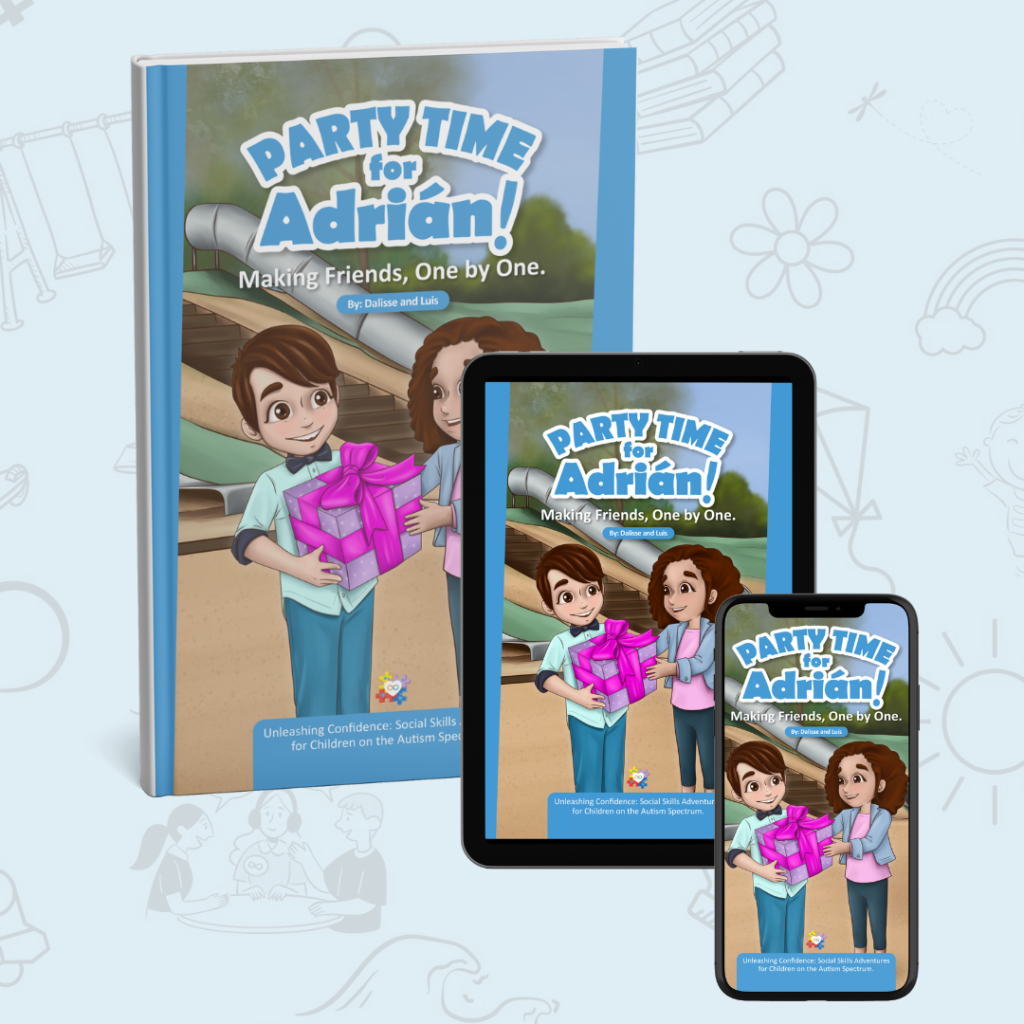
    That experience inspired me to write Party Time for Adrián: Making Friends One by One. This heartwarming story follows Adrián as he navigates a birthday party with the help of his friends, supportive family, and a few key social strategies. It’s a resource for parents, caregivers, and educators who want to help autistic children feel prepared and confident in social situations.

    My New Book: Party Time for Adrián!

    Cover of 'Party Time for Adrián: Making Friends One by One', a children's book about social skills and friendship for kids with autism.

    You’re Not Alone

    Raising autistic children comes with its own set of challenges, but it’s also an incredibly rewarding journey. Social gatherings might feel daunting at first, but with the right tools and support, our kids can thrive.

    Let’s Connect!

    What strategies have worked for your child at social events? Share your tips in the comments—I’d love to hear from you!

    Together, we can create a more inclusive and supportive world where our autistic children can shine.

    With hope and joy,

    Dalisse – Loving Pieces Books