



I have a confession. I was scrolling through Instagram last week, mindlessly passing by vacation photos and recipes, when my feed stopped me cold. There she was. The new Autism Barbie. I read the caption, zoomed in on the photos, and right there on my kitchen floor, I was so happy.
A yeiii scream came out instantly out of my mouth. The kind that come from a place so deep inside you didn’t even know it was waiting to be vocalized.
Let me back up. I grew up in the 90s, a dedicated Barbie girl. I spent hours playing with my sister and our dolls, orchestrating elaborate play scenarios, silent stories in my head. But in all those stories, I never saw an autistic barbie, I remember the astonaut, the teacher, the fashion barbie. Even growing up with the AI I even saw a couple memes of reiki barbie (which I loved). I am a late-diagnosed autistic woman, and for most of my life, that part of me felt invisible, even to myself. I guess when I was young playing with Barbie was an escape, but it was also a quiet reminder that I didn’t fit the mold of the shiny, smiling, chatty world she represented.
Now, I’m a mom to two incredible autistic boys, Adrián and Guille. My life is about advocating for their right to be seen. But sitting there with my phone in my hand, something shifted. This wasn’t just about them. This was about me. The little girl I was, who stimmed (masked a lot!) and daydreamed and felt different, finally had a reflection.
Why This Feels Like a Hug for My Inner Child
The details are what undid me. This isn’t just a blonde, blue-eyed doll with a puzzle piece printed on her shirt (thank goodness). She’s a woman of color with a gentle, averted gaze. She’s wearing soft, comfortable clothes you could actually relax in. And she comes with tools that are lifelines in our home: noise-canceling headphones, a fidget ring, and an AAC tablet.
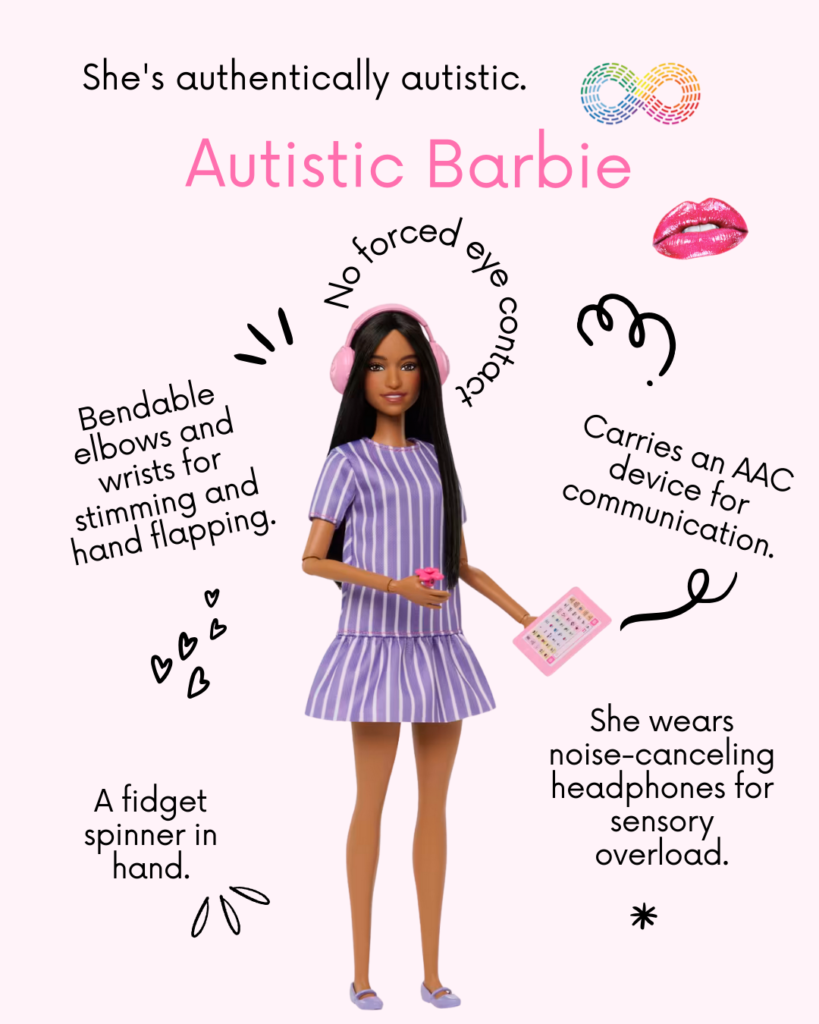
Seeing these items packaged not as medical equipment, but as part of a beautiful, stylish doll’s world… it legitimizes them. It tells the little girl I was, and it tells my sons now, that these tools aren’t markers of being “less than.” They are smart, helpful accessories for navigating a loud world. They are part of the story.
I’ve read so many comments from other autistic adults who feel the same way.
There’s a shared sense of being seen, often for the first time, in a mainstream toy aisle. Many of us are saying the same thing: I wish I had this when I was a kid.
The Grateful Heart and The Nuanced Mind
Now, let me put my mom-and-advocate hat on for a second. My heart is full, but my mind is realistic. I am deeply grateful to see that Mattel consulted with the Autistic Self Advocacy Network (ASAN) and based the doll on a real, autistic girl. That matters. It moves this from inspiration to collaboration.
But I also hear the valid concerns echoing in our community. And I feel them too.
The Spectrum is So Much Wider Than One Doll
The biggest, most important conversation is this: autism is a spectrum of billions of unique people. One doll, with one skin tone, one hair texture, and one set of accessories, cannot possibly represent everyone. There’s a real risk that for a non-autistic person, this could slip into a new stereotype: “This is what autism looks like.” We need more. We need different body types, different genders, different sensory tools, and different expressions of being autistic.
I’ve seen a brilliant suggestion: what about an accessory pack? A set of headphones, AAC devices, and fidgets that could snap onto any Barbie or Ken? That would let a child customize a doll to look like them, or their sibling, or their friend. That feels powerfully inclusive.
What This Means for Our Kids (And Their Classmates)
Beyond my own healing, I keep thinking about what this means in practical terms for my boys and their peers.
For Guille, who is largely nonverbal and has used an AAC device, seeing that tablet in a Barbie’s hand isn’t just a toy. It’s a mirror that says, “Your voice is valid.” For Adrián, who needs his headphones to survive loud noises, it normalizes his need for quiet as just another way to be.
And for their neurotypical classmates? This is a gentle, powerful teaching tool. It introduces accommodations not as something strange, but as normal, helpful parts of life. It can spark questions and conversations that build empathy, not pity. When disability representation sits on the shelf next to the veterinarian Barbie and the president Barbie, it sends a message: this is part of our world. This belongs.
Holding Space for Complicated Feelings
The online discourse around this doll has been… intense. And as a community, we’re exhausted by storms. I’ve seen people dismiss the excitement with, “It’s just a kids’ toy.” But it’s never just a toy. Toys are the blueprints of our imaginations. They tell us who gets to be the hero, who gets to be beautiful, who gets to be seen.
I also understand the distrust. It’s a corporation. It’s about profit. Can real representation and capitalism coexist? It’s a fair and painful question. We can be grateful for the step forward and still demand more steps, more variety, and more authentic inclusion in the future.
A Step Forward on a Long Path
So, here’s my take, as a late-diagnosed autistic woman and a mom.
This Autism Barbie is not the entire answer. She is not a perfect representation of a wildly diverse spectrum. But she is a meaningful, heartfelt step. She is proof that advocacy is working. She is a signal to companies that authentic representation matters to consumers.
This is why I write the books I do. At Loving Pieces Books, I create stories where autistic kids are the main character. I know that no single book, just like no single doll, can represent all autistic children. My Adrián and my Guille are proof of how different two experiences can be, even in the same family. But a story can be a starting point. It can be that first, vital mirror for one child, and a window of understanding for another. It can be the spark for a conversation between a parent and a teacher, or the reason a child feels a little less alone. That’s the power of representation; it’s not about capturing everything, but about honestly capturing something that opens a door.
For me, this doll is a chance to heal a childhood wound I didn’t even know I had. To tell that little girl inside me: You were always here. And you were always beautiful.
And for my sons, she is one more brick in the world I’m trying to build for them, a world where they see themselves reflected back, not as an afterthought, but as a main character. Worthy of being on the shelf, exactly as they are.
What do you think? Does this doll feel like representation to you? Let’s have a kind, nuanced conversation about it.
With Love,
Dalisse
Just in case you need it here is the link to Buy the Autistic Barbie: https://amzn.to/3NF5dyQ